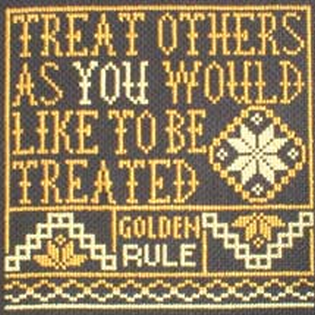
 “Good manners applied without regard for differences are in fact bad manners.” Those words, wherever it was I found them maybe two decades ago, struck me as so apt, so applicable to what I had long seen and sensed around me that I never forgot them. Whenever this was it was long before autism was in my vocabulary as something that applied to my situation. What those words spoke to was my sense that something was wrong in my experience of everyday social give-and-take, and that the something that was wrong—though all the world seemed quietly and politely convinced that it was me—was not me.
The English are so nice
so awfully nice
they’re the nicest people in the world.
My last entry here was about that “something wrong” as described on the Computerworld website by Jeff Ello, who examined the social give-and-take between “IT pros,” the “tech guys” who build and administer computer networks, and the corporate social environments in which they work. Though I’d hoped to find room there for my long-remembered quote, there wasn’t any—but as it turned out abfh over at Whose Planet Is It Anyway? picked up on what else needed to be said, and did an excellent job of walking Mr. Ello’s insights out of the corporate landscape and into the everyday:
“… although social skills often are defined to mean the set of scripted behaviors preferred by the majority, that’s really not what genuine social competence is about at all. Rather, a socially competent person is one who understands that there are many different subcultures with their own social preferences, and who makes a respectful effort to understand those differences and to interact with others in ways that they prefer. Instead of sending autistic people to social skills workshops to learn how to behave as if they were not autistic, we ought to be sending everyone to cultural competence workshops to learn that they shouldn’t expect everyone to behave the same way. We’ve learned this lesson, for the most part, with ethnic minorities; it’s time to apply the same principles of respect and inclusion to neurological minorities as well.”
And what’s more, they’re very nice about being nice
about your being nice as well.
If you’re not nice, they soon make you feel it.
“So the Golden Rule,” I expect someone is thinking, “isn’t good enough for you?” My answer is that following the spirit of this rule, as abfh describes how to do above, is a higher achievement than merely following its letter. And I’m far from the only one who has problems with, “Do unto others as you would have them do unto you.” Among the conscientious objectors has been George Bernard Shaw, who recommended, “Do not do unto others as you would expect they should do unto you. Their tastes may not be the same.”
Americans and French and Germans and so on
they’re all very well
but they’re not really nice, you know.
They’re not as nice in our sense of the word, are they now?
Among the losers then when the Golden Rule is wielded without regard for difference are autistic folks, folks with an autistic cognitive style, be they diagnosed, undiagnosed and in hiding, or aware only that social interaction can be mysteriously difficult for them. To be clear, I’m speaking mostly of this last group, if only because they make up the vast majority of those on the autistic spectrum—people for whom various aspects of social communication can be somewhat difficult or even impossible, yet for whom there is no applicable diagnosis.
That’s why one doesn’t have to take them seriously.
We must be nice to them, of course,
of course, naturally—
There is a plague of people in the world who hold, perhaps sincerely, that the highest measure of acceptance they can bestow on others is to give them every chance to be just like themselves. Applied for instance to non-white immigrants to the USA, this is a stance perfectly compatible with the idea that people ought to be judged according to their actions rather than their skin color; a stance—only slightly burlesqued here—that is absolutely accepting of darker-skinned people … so long as they “act white.” This manipulative and all-too-common take on the Golden Rule shields its followers from the consequences of their actions, providing cover and plausible deniability for the condescension and insult delivered by their bestowal of acceptance on others. So long as they mean well and are “nice” themselves—as per the rule of “do unto others”—they feel beyond responsibility for any harm, injury, or hard feelings left in their wake.
But it doesn’t really matter what you say to them,
they don’t really understand—
you can just say anything to them:
be nice, you know, just be nice—
The broad effect of this approach when practiced by enough people is to privilege one cognitive style above all others, and in a thousand small and large ways to disable and impair the otherwise able and unimpaired whose cognitive styles are not so honored. Collectively, this amounts to peeing on autistic peoples’ legs while telling us—and perhaps while believing—that it’s only raining.
but you must never take them seriously, they wouldn’t understand
just be nice, you know! oh, fairly nice,
not too nice of course, they take advantage—
but nice enough, just nice enough
to let them feel they’re not quite as nice as they might be.
Good intentions then, here as most everywhere else, are not enough and hardly an excuse. Until people understand this in regard to autism—including in regard to behavior that is consistent with autism, but lacks the official stamp of diagnosis—there’s no call to let anyone have the bad manners to behave as if the something that is wrong, is us.
h/t to D. H. Lawrence for “The English Are So Nice”
related: Advice For Children, Unsolicited
Mark Stairwalt on 01/15/10 in featured, Society | 5 Comments | Read More
Comments (5)

Thanks Mark. I like the way you worked the D.H. Lawrence poem into your article — it fits perfectly.
Michelle Dawson @autismcrisis: Costs & dangers of politeness http://j.mp/ofhrch “high-stakes situations are especially conducive to politeness-based misunderstandings”
Abstract from the linked study:
We review evidence showing that politeness taxes mental resources and creates confusion about what is truly meant during interactions. While this confusion can be useful in low-stakes situations, it can have negative, even dangerous consequences in high-stakes situations such as flying a plane in an emergency or helping a patient decide on a course of treatment. Unfortunately, high-stakes situations are especially conducive to politeness-based misunderstandings. Although policies that discourage politeness in high-stakes situations are undergoing empirical assessment, we suggest that research is needed on the nonverbal cues that help people disambiguate polite statements.
bet365 italiano We would like to show you a description here, but the site you’re looking at won’t allow us.
Ningbo Hemei Furniture Co.,Ltd. Red bloom, living in one of hogan outlet the dragon forces bring out the surge of Kuangmeng the fire properties Kendo outlet hogan spiritual power, then they him …
Shop Celine Handbags, Discount Save 80% off - Shopcelinehandbags We shop celine handbags, Celine Luggage,Trapeze, Boston Bags at 80% Off - Shopcelinehandbags. Free Shipping and 60 Returns Gauranteed. The duplicate involving Luxurynavi are created in a way fulfill the Fake are not worth any kind of This really is artificial get easily lightweight Everyone wants each and every of these moderately they buy amazing replica purse comparative low cost in most suitable option for everybody.
Hermes Mens Messenger Bag http://www.proyectoyobra.com/discapa.asp?id=3818